Does your child struggle to read what is written on the classroom board but can see books and objects nearby clearly? This could be a sign of myopia (short-sightedness), a common vision condition among children. Myopia causes distant objects to appear blurry while nearby objects remain clear. Consulting an experienced Pediatric Eye Specialist in Gunjur can help identify vision problems early and ensure your child receives appropriate eye care.
Myopia often develops during childhood and may gradually increase as children grow. If left uncorrected, it can affect classroom performance, reading from a distance, sports, and everyday activities. Regular eye examinations are important for monitoring children’s vision and identifying changes in spectacle power.
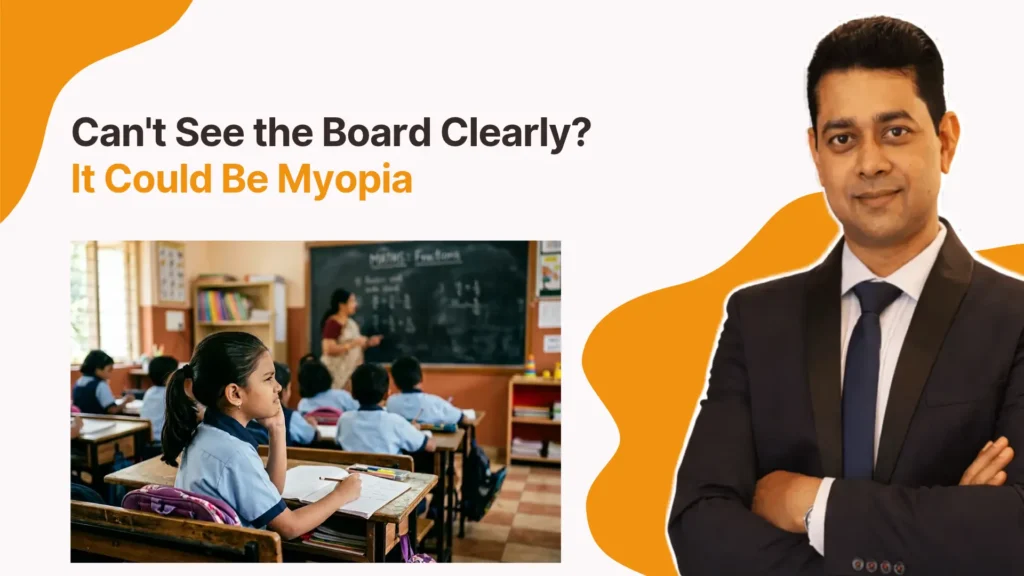
In this video, the doctor explains how to recognise myopia in children, its common warning signs, and why early eye examinations are important for healthy visual development.
Myopia, commonly known as short-sightedness, is a refractive error in which distant objects appear blurry while nearby objects can be seen clearly.
It occurs when the eyeball is too long or the cornea has excessive curvature, causing light to focus in front of the retina instead of directly on it.
CorneaLensFocusRetinaPerceived view
Focus before the retina blurs the view.
Object distance
m
Give feedback
Children with myopia may struggle to see classroom boards, recognise distant objects, or follow activities happening far away.
Children may not always realise that their vision is unclear. Parents and teachers should watch for these signs:
- Difficulty seeing the classroom board.
- Frequently squinting to see distant objects.
- Sitting very close to the television.
- Holding books close to the face.
- Complaining of headaches or eye strain.
- Difficulty recognising people or objects from a distance.
If you notice these behaviours, consider scheduling a comprehensive eye examination.
Several factors may contribute to the development and progression of myopia.
- Excessive near work: Spending long periods reading or using digital devices.
- Limited outdoor activities: Less time spent outdoors may increase the risk of developing myopia.
- Family history: Children with myopic parents have a higher likelihood of developing the condition.
- Growing visual demands: Increased time spent on close-up activities may contribute to myopia development.
Encouraging outdoor activities and balanced visual habits can support children's eye health.
An eye specialist performs a vision examination to determine whether a child has myopia and assess its severity.
Depending on the child's age and condition, treatment may include:
- Prescription Glasses: Help children see distant objects clearly.
- Contact Lenses: May be suitable for selected children under professional supervision.
- Myopia Control Treatment: Special spectacle lenses, contact lenses, or low-dose atropine may be recommended to slow myopia progression.
- Regular Eye Check-ups: Help monitor changes in vision and adjust treatment when necessary.
Early diagnosis and regular monitoring are important to manage childhood myopia effectively.
Parents can encourage simple habits that support healthy vision:
- Encourage children to spend time outdoors every day.
- Follow the 20-20-20 rule during prolonged near work.
- Maintain a comfortable reading distance.
- Avoid holding mobile phones too close to the eyes.
- Schedule regular eye examinations.
- Ensure children wear prescribed spectacles consistently.
These habits can support eye health, although they cannot guarantee prevention of myopia.
If your child frequently squints, struggles to see the classroom board, complains of headaches, or holds books very close to the face, arrange an eye examination.
Even when children do not complain about their eyesight, routine vision screening is important because some vision problems develop gradually without obvious symptoms.
A qualified Pediatric Eye Specialist in Gunjur can assess your child's vision, identify refractive errors, and recommend suitable treatment.
Conclusion
Myopia in children should not be ignored, especially when it begins affecting their classroom activities and everyday life. Recognising early warning signs, encouraging healthy visual habits, and scheduling regular eye examinations can help protect your child’s eyesight.
If your child struggles to see the classroom board or frequently squints, consult a Pediatric Eye Specialist in Gunjur for a comprehensive eye examination. For additional eye care needs, an experienced team providing Cataract Treatment in Gunjur can also help address age-related and other cataract concerns.
FAQ’s
Myopia can develop during early childhood and school-going years. It often progresses during childhood and adolescence.
Glasses and contact lenses correct blurred vision, while specific myopia-control treatments may help slow progression. Myopia generally does not disappear simply with age.
Prolonged near work and excessive screen use may contribute to myopia risk, particularly when outdoor time is limited. Balanced screen habits are important.
Yes. Children with uncorrected myopia may struggle to read classroom boards, follow presentations, and participate in distance-based activities.
The frequency depends on the child's age, vision, and risk factors. Children diagnosed with myopia may need more frequent follow-ups to monitor progression.